
This is not medical advice. This information is for education and entertainment purposes. Seek Professional Guidance and support with any lifestyle and nutritional change.
You have heard me talk about frequencies for so long, so here are some further thoughts for you.
Frequencies in Mainstream Medicine
The concept of frequencies crossing over into modern medicine involves the application of specific vibrational or electromagnetic frequencies to diagnose, treat, or manage health conditions, blending principles from physics, biology, and technology.
This holistic definition encompasses several key areas where frequencies are utilized in medical practice, integrating both established and emerging approaches.
If any of the below seems to scientific, just skim over. You will recognise some of the terminology that is in everyday use.
- Imaging Technologies:
- MRI (Magnetic Resonance Imaging): MRI uses radio frequency (RF) pulses in the presence of strong magnetic fields (typically 1.5–3 Tesla, corresponding to RF frequencies in the range of 60–128 MHz) to excite hydrogen nuclei in the body. The resulting signals are used to create detailed images of tissues and organs, enabling non-invasive diagnosis of conditions like tumors, brain disorders, and musculoskeletal issues.
- Ultrasound: High-frequency sound waves (1–20 MHz) are used to visualize internal structures, such as fetuses during pregnancy or organs like the heart. Ultrasound relies on the reflection of acoustic frequencies to produce real-time images.
- EEG (Electroencephalography): Measures electrical frequencies (0.5–100 Hz) generated by neuronal activity in the brain to diagnose conditions like epilepsy, sleep disorders, or brain injuries.
- Biosensors and Spectroscopy: Techniques like near-infrared spectroscopy (NIRS) use specific light frequencies (700–2500 nm) to measure tissue oxygenation or metabolic activity, aiding in diagnostics for conditions like stroke or cardiac issues.
Therapeutic Applications of Frequencies
Frequencies are increasingly used in therapeutic interventions, leveraging electromagnetic, acoustic, or vibrational energy to influence biological processes:
- Electromagnetic Therapies:
- Transcranial Magnetic Stimulation (TMS): Uses low-frequency magnetic pulses (1–20 Hz) to stimulate brain regions, treating conditions like depression, anxiety, or chronic pain. The magnetic fields induce electrical currents in targeted neural tissues, modulating activity.
- Pulsed Electromagnetic Field (PEMF) Therapy: Applies low-frequency electromagnetic fields (1–100 Hz) to promote tissue repair, reduce inflammation, or alleviate pain in conditions like arthritis or fractures. The mechanism involves stimulating cellular repair processes, such as ion channel activity or ATP production.
- Radiofrequency Ablation (RFA): High-frequency RF waves (400–500 kHz) are used to generate heat and destroy abnormal tissues, such as tumors or arrhythmic heart tissue, with precision.
- Ultrasound Therapy:
- High-Intensity Focused Ultrasound (HIFU): Uses focused ultrasonic waves (0.5–10 MHz) to ablate tissues, such as in prostate cancer treatment, by generating localized heat or mechanical disruption.
- Low-Intensity Ultrasound: Applied to accelerate bone healing or tissue regeneration by stimulating cellular activity through acoustic vibrations.
- Photobiomodulation (Low-Level Laser Therapy): Uses specific light frequencies (typically 600–1000 nm) to promote wound healing, reduce inflammation, or manage pain by stimulating mitochondrial activity and ATP production.
Bioenergetic and Vibrational Medicine
Some holistic medical practices incorporate frequencies based on the idea that the body has its own resonant frequencies, which can be influenced to restore health:
- Biofield Therapies: Practices like Reiki or therapeutic touch use subtle energy fields (sometimes described as vibrational frequencies) to promote healing.
- Sound Therapy: Uses specific sound frequencies (e.g., 432 Hz or 528 Hz, often termed “healing frequencies”) to promote relaxation or emotional well-being.
- Rife Machines: These devices claim to use specific electromagnetic frequencies to target pathogens or diseased cells.
Emerging and Experimental Applications
Advancements in frequency-based technologies are pushing the boundaries of medical science:
- Neuromodulation: Techniques like deep brain stimulation (DBS) use implanted electrodes delivering specific electrical frequencies (130–185 Hz) to treat Parkinson’s disease, epilepsy, or chronic pain by modulating neural circuits.
- Optogenetics: An experimental technique using light frequencies to control genetically modified neurons, offering potential for precise treatment of neurological disorders.
- Nanotechnology and Frequency-Based Drug Delivery: Emerging research explores using electromagnetic or acoustic frequencies to trigger drug release from nanoparticles at targeted sites, such as tumors, enhancing precision in chemotherapy.
Scientific and Holistic Integration
The use of frequencies in medicine bridges conventional science and holistic perspectives:
- Scientific Basis: Frequencies interact with biological systems at the cellular or molecular level, influencing ion channels, protein structures, or gene expression. For example, electromagnetic fields can alter calcium signaling in cells, impacting processes like inflammation or tissue repair.
- Holistic Perspective: Some practitioners view the body as a complex system of vibrational energies, where imbalances in these energies (or frequencies) contribute to disease. This aligns with traditional systems like Ayurveda or Traditional Chinese Medicine.
Future Directions
The integration of frequencies into medicine is likely to expand with technological advancements:
- Personalized Frequency Medicine: Advances in bioinformatics may allow tailored frequency-based treatments based on an individual’s unique biological resonances or genetic profile.
- Wearable Devices: Wearables using low-frequency electromagnetic or vibrational signals could monitor or modulate physiological states in real time, such as managing stress or enhancing sleep.
- AI and Frequency Optimization: AI-driven models, could analyze vast datasets to optimize frequency-based therapies for specific conditions, improving efficacy and personalization.

Solfeggio Frequencies
Solfeggio frequencies are specific sound frequencies, measured in Hertz (Hz), historically used in sacred music and now valued in holistic practices for promoting physical, emotional, and mental well-being.
These frequencies, such as 174 Hz (pain relief), 528 Hz (healing and transformation), and 741 Hz (detoxification and intuition), are believed to resonate with the body’s energy, enhancing relaxation and balance. (Journal of Alternative and Complementary Medicine, 2018).
How Solfeggio Frequencies Support Bio-Individuality
Chronic stress can impair the potential health of our physical and mental body.
Our hierarchy of health has established a framework for you to understand holistic well being and the interconnectedness of your physical and emotional body.
Our cells and organs have been mapped to certain frequencies. Current science supports this timeless wisdom in how frequencies can repair cells, eliminate poor cells and assist the body to work at its full potential.
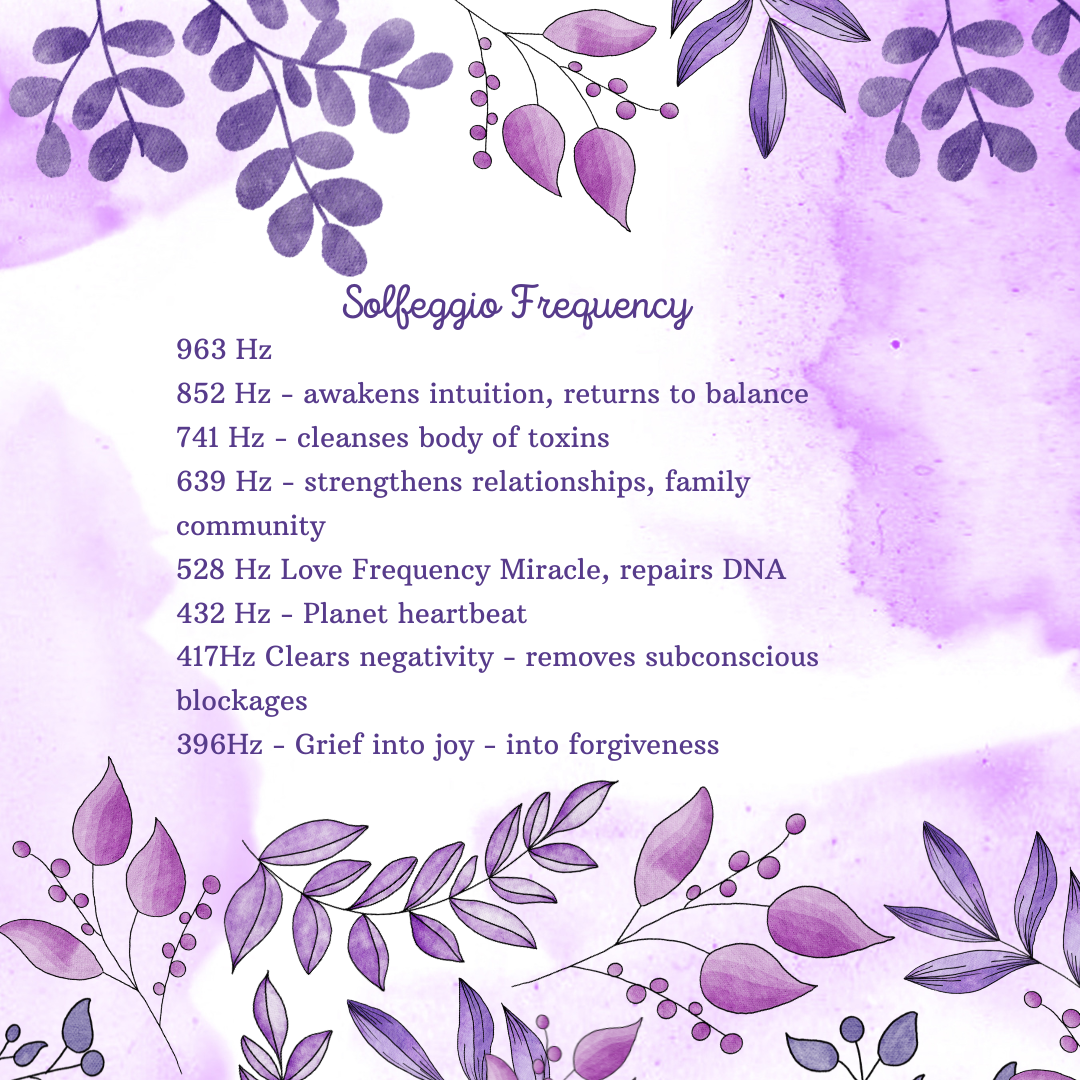
The musical resonance and sounds come to balance our energetic body.

This YouTube clip has explanations to the frequencies
Some Further Frequencies
Below is a curated list of frequencies used in frequency therapy and healing technologies.
Each condition is matched with its most effective vibrational range — decoded from decades of research.
These are not mere numbers.
They are resonance keys.
Acne – 10–15 Hz
Allergies – 5–10 Hz
Alzheimer’s Disease – 2–8 Hz
Angina – 2–8 Hz
Anxiety – 2–8 Hz
Arrhythmia – 7–8 Hz
Arteriosclerosis – 7–10 Hz
Asthma – 7–10 or 12–15 Hz
Blepharitis (Chronic) – 1–2 Hz
Bronchitis – Acute: 4 Hz, Chronic: 12 Hz
Bruises – 10–14 Hz
Carpal Tunnel Syndrome – 6 or 20 Hz
Cervical Vertebra Pain – 15–20 Hz
Chronic Pelvic Pain – 5–7 Hz
Circulatory Dysfunction – 7–10 Hz
Constipation – 5 Hz
Crohn’s Disease – 12–22 Hz
Cystitis – 5–8 Hz
Dental/Oral Issues – 30 Hz
Depression – 3 or 20 Hz
Diabetes – 12–22 Hz
Dizziness – 10–15 Hz
Eczema – 10–15 Hz
Erectile Dysfunction – 6 Hz
Fibromyalgia – 18 Hz
Fractures / Nonunion – 10 or 20 Hz
Frozen Shoulder – 7–8 Hz
Glaucoma / Optic Nerve Atrophy – 12–22 Hz
Headache – 3 or 6–10 Hz
Hepatitis – 12–22 Hz
Herniated Disc – 16–20 or 30 Hz
High Blood Pressure – 1–5 Hz
Hyperactivity – 20 Hz
Immune Boosting – 24 Hz
Joint Issues / Sprains – 10 Hz
Ligament Injuries – 10–15 Hz
Low Blood Pressure – 20–24 Hz
Lumbago – 10 or 20 Hz
Lymphatic Disorders – 12–22 Hz
Menopause – 5–8 Hz
Menstrual Pain – 5–7 Hz
Migraines – 4–10 Hz
Multiple Sclerosis – 5, 13 or 20 Hz
Muscle Strains – 11–15 Hz
Musculoskeletal Pain – 10 Hz
Nerve Pain / Neuropathy – 6 Hz
Neuralgia Trigemini – 15–20 Hz
Neurodermatitis – 10–15 Hz
Osteoarthritis – 8–12 or 18 Hz
Osteonecrosis / Osteochondrosis – 10 or 19–20 Hz
Osteoporosis – 8–10 or 15–19 Hz
Pain from Wounds – 11–15 or 17 Hz
Parkinson’s Disease – 20 Hz
Periostitis – 6 Hz
Phantom Pain – 16–19 Hz
Poor Circulation – 2–6 or 20 Hz
Prostatitis – 3–8 Hz
Psoriasis / Psoriatic Arthritis – 12–22 Hz
Psychosomatic Syndrome – 22 Hz
Raynaud’s Syndrome – 15 Hz
Respiratory Issues – 12–22 Hz
Rheumatoid Arthritis – 10 or 20 Hz
Sciatica – 16–20 Hz
Skin Allergies / Ulcers / Bedsores – 10–15 Hz
Sleep Disorders – 1–5 Hz
Spinal Injuries – 12–22 Hz
Stomach Aches – 10 Hz
Stress – 3 or 5 Hz
Stroke Recovery – 7–10 or 20 Hz
Swelling (Edema) – 10 Hz
Systemic Lupus (SLE) – 12–22 Hz
Tendinitis – 8 Hz
Tinnitus – 10 Hz
Tuberculosis (TB) – 4 Hz
Wound Healing – 1–5 Hz
 Maree Frawley