
2. Water
Why it’s second:
Water is essential for nearly every bodily function, including temperature regulation, nutrient transport, and waste elimination.
The body is ~60% water, and dehydration disrupts homeostasis, leading to organ failure if prolonged.

Everyday Language
Your body is mostly water—about 60%!
Water keeps everything working, like cooling you down, moving nutrients around, and getting rid of waste.
If you don’t drink enough water, you get dehydrated, which messes up your body’s balance and can make your organs struggle or even fail if it goes on too long.
Think of water like the oil in a car—it keeps everything running smoothly!
Scientific explanation – You can skip this
- Water maintains blood volume and pressure, critical for oxygen delivery and waste removal (Guyton and Hall Textbook of Medical Physiology, 14th ed.).
- Dehydration reduces plasma volume, impairing circulation and causing organ stress. Severe dehydration (loss of ~15% body water) is fatal.
- Water is a solvent for biochemical reactions, including enzyme function and electrolyte balance (Lehninger Principles of Biochemistry, 7th ed.).
Time to impact:
Days (typically 3–7 days without water, depending on conditions).
Why Filtering Water is so important!
Filtered water is crucial for health because it removes harmful heavy metals like lead, mercury, and cadmium, which can accumulate in the body and disrupt organs, hormones, and the nervous system (Journal of Environmental and Public Health, 2020).
Your body, being ~60% water, relies on clean water to flush toxins, regulate temperature, and transport nutrients.
Using filtered water for drinking, tea, and coffee is key, as boiling tap water laden with chemicals can concentrate heavy metals, making them more harmful (Environmental Science & Technology, 2019).
Opt for a high-quality filter (e.g., reverse osmosis) and avoid boiling unfiltered tap water to support safe, holistic detox and overall wellness.
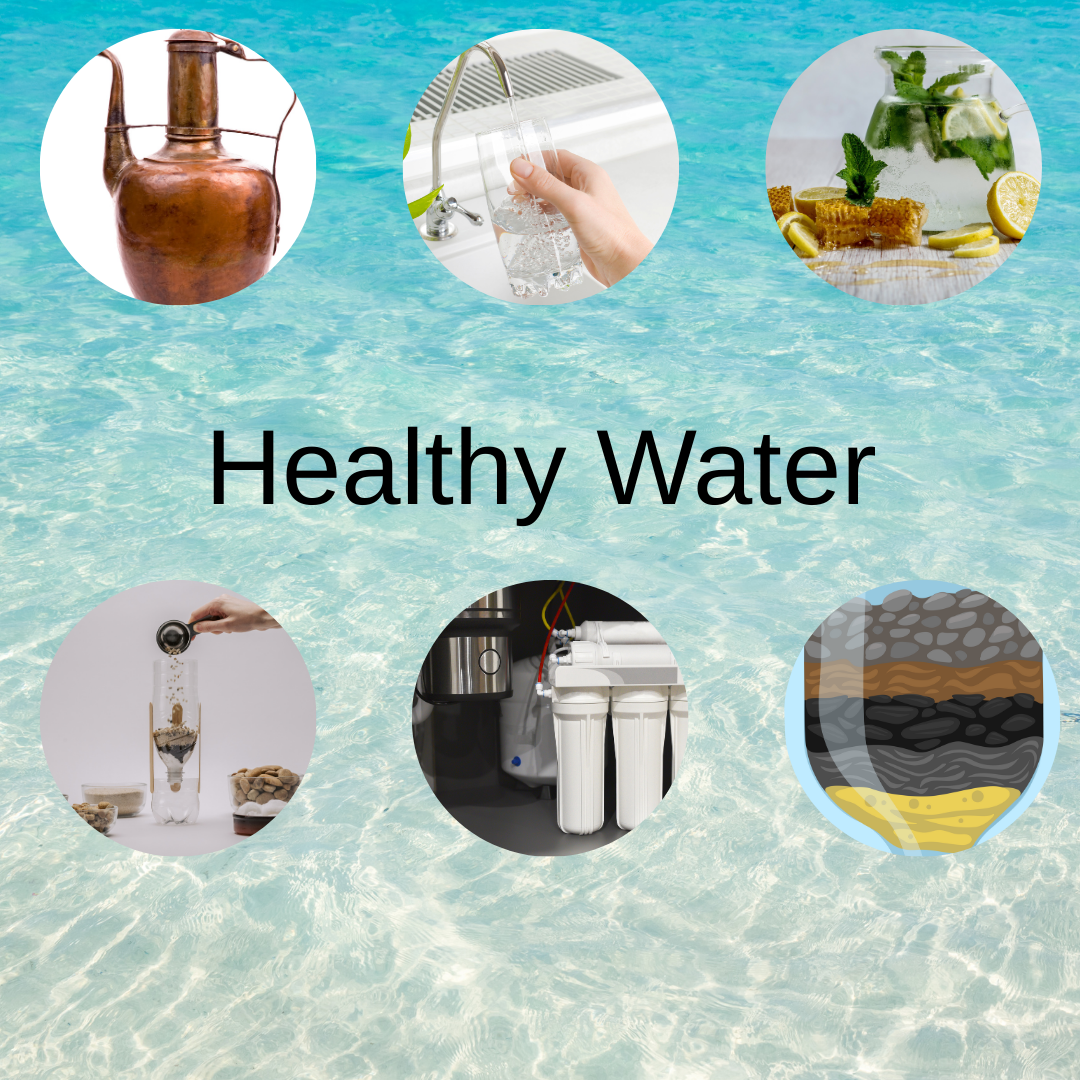
There are many options for water filters. When you start researching, remember the basics of consumer products. See the last section on this page for some guidelines for researching water filtration systems for your needs.
Summary In Everyday Language
Water keeps your body’s systems flowing—like oil in a car.
Without it, you overheat, you
Integrated Action
Water is essential for flushing toxins, maintaining blood volume, and supporting kidney filtration.
It’s critical for heavy metal detox, as kidneys excrete water-soluble toxins.
Hydration goal
- Drink 2–3 liters of filtered water daily (use a glass or stainless steel container to avoid microplastics). Add a pinch of Himalayan salt for electrolytes to balance Vata and Pitta doshas (Ayurveda: The Science of Self-Healing, Lad, 1984).

Researching Water Filtration Systems
When researching water filter systems for town water (municipal supply) and tank water (rainwater), consider these key questions in simple, layman’s terms to guide your decision.
These questions align with a holistic focus on clean water for detoxification, especially heavy metal removal, and account for concerns like chemicals, as well as the role of water in supporting the nervous system and overall health.
- What’s in my water?
- Why: Town water often has chlorine, fluoride, or heavy metals (like lead from old pipes), while tank water can have dirt, bacteria, or acidic pH (CDC, 2024). Knowing what’s in your water helps pick the right filter.
- Ask: Can I test my water (e.g., lab test for tank water or town water quality report) to find out about heavy metals, chemicals, or germs?
- What does the filter remove?
- Why: Not all filters catch everything. Some remove chlorine for taste, others tackle heavy metals (like mercury) or bacteria, which is key for detox (Journal of Ethnopharmacology, 2013). Tank water needs sediment and bacteria filters; town water needs chemical and metal removal.
- Ask: Does this filter remove heavy metals, chlorine, pesticides, or bacteria? Is it certified to prove it works?
- Do I need a filter for one tap or the whole house?
- Why: Point-of-use filters (e.g., under-sink) are great for drinking and cooking, while whole-house filters clean all water (e.g., for bathing, which helps skin and nervous system health). Whole-house filters for tank water may need extra steps like pH neutralization (mywaterfilter.com.au, 2018).
- Ask: Do I want clean water just for drinking, or for showering and washing too? Will a whole-house filter fit my space and budget?
- How much maintenance is needed?
- Why: Filters need regular cleaning or replacement to avoid germ buildup or clogging, which could affect detox efforts (Good Housekeeping, 2025). This supports your goal of nurturing wellness without extra stress.
- Ask: How often do I need to change the filter? Is it easy to maintain, or do I need a pro?
- Does it waste water or remove good stuff?
- Why: Some filters, like reverse osmosis, waste water (3–5 times what they clean) and strip healthy minerals (e.g., magnesium), which are vital for nervous system health (EWG, 2024). This matters for holistic balance and avoiding hormone-disrupting deficiencies.
- Ask: Will this filter waste a lot of water? Can I add minerals back (e.g., with an alkalizing cartridge)?
- Is it safe for my tank water’s unique needs?
- Why: Tank water can be acidic or have sediment and bacteria from roofs or tanks, unlike treated town water with added chemicals like chlorine (mywaterfilter.com.au, 2018). Filters for tank water need to address these without overcomplicating detox.
- Ask: Does this filter handle sediment, bacteria, or acidic water for tanks? Is it different from what town water needs?
- Can it support my detox goals?
- Why: Clean water is key for flushing heavy metals (like mercury from fillings, as you mentioned) and chemicals that act like “sugar toxins” by stressing the body (Journal of Environmental and Public Health, 2020). Coriander’s chelating properties pair well with filtered water to enhance detox.
- Ask: Will this filter remove heavy metals and chemicals to support my body’s cleanse, especially if I’m using coriander or chlorella?
Quick Tip: Get a water test (e.g., Tap Score kit) for both town and tank water to know exactly what’s in it. Pair your filter with holistic practices like drinking filtered water with a pinch of Himalayan salt to support hydration and nervous system health, aligning with your Ayurveda and wellness focus (Ayurveda: The Science of Self-Healing, Lad, 1984).
Further considerations
- There are water filtration systems that are multi-level marketing. Rather than getting sucked in with their great marketing, pause and do some research as you may be able to get a similar product that is as effective if not more effective and cheaper.
- LIVING WATER is a great area to research! There are so many components in this subject. Light, movement, and enhancements to increase the energy of the water.
Copper
Storing water in a copper vessel can offer holistic health benefits, rooted in Ayurvedic tradition and supported by some scientific evidence.
Copper has natural antimicrobial properties, which can help kill bacteria and pathogens in water, making it safer to drink, especially for tank water users (Journal of Health, Population and Nutrition, 2012).
It may also support digestion, boost immunity, and aid detoxification by enhancing liver function, which aligns with heavy metal cleansing (Ayurveda: The Science of Self-Healing, Lad, 1984).
Drinking copper-infused water (after storing for 6–8 hours) can provide trace amounts of copper, a mineral essential for nervous system health and enzyme function, though excessive use should be avoided to prevent toxicity (Nutrients, 2017).
This practice complements a holistic focus by promoting clean water and subtle detox benefits.
Safety Note: Use a pure copper vessel, limit storage to 6–12 hours, and consult a doctor if you have concerns about copper intake, especially with existing health conditions. Some copper vessels are treated with heavy chemicals to prevent discolouration, so please check!
Colloidal Silver
Colloidal silver is tiny silver particles floating in water, used for centuries to kill germs because of its antibacterial properties. It’s sometimes added to water filters or used as a treatment to make water safer to drink, especially in places where clean water is hard to get. (Journal of Ethnopharmacology, 2013).
Benefits:
- Kills germs: Silver can stop bacteria, some viruses, and fungi from growing by messing with their DNA, making water safer (Journal of Biomedical Materials Research, 2000). It’s used in some filters (like ceramic or carbon ones) to prevent bacteria buildup (Water Technology, 2010).
- Helps in emergencies: For tank water or travel, colloidal silver in filters can reduce harmful microbes, (Battlbox, 2025).
- Works with other filters: Silver paired with carbon or ceramic filters removes bacteria and some contaminants, improving water quality for detox (Water Purification Guide, 2020).
Risks
- Not safe to drink in excess: Adding colloidal silver to water yourself can be risky. Too much silver can build up in your body, causing argyria (blue-gray skin) or damage organs like the liver, kidneys, or nervous system (Healthline, 2024; WebMD, 2024). The World Health Organization says silver in water should stay below 0.1 mg/L to avoid health issues (Water Technology, 2010).
- Doesn’t remove all toxins: Silver kills germs but doesn’t remove heavy metals (like mercury from fillings) or chemicals. This limits its detox benefits compared to filters like reverse osmosis (Water Purification Guide, 2020).

Frequencies and Words Affecting Water Molecules
The primary work referenced is The Hidden Messages in Water by Dr. Masaru Emoto, a Japanese researcher and author (1943–2014).
Published in 2004, this New York Times bestseller presents Emoto’s experiments on the effects of human consciousness, words, and sounds on water’s molecular structure.
Dr. Emoto’s experiments involved exposing water samples to various words, thoughts, prayers, or music, then freezing the water and examining the resulting ice crystals under a microscope.
He claimed that water exposed to positive words (e.g., “love,” “gratitude,” “peace”) or uplifting music (e.g., classical) formed beautiful, symmetrical, snowflake-like crystals, while water exposed to negative words (e.g., “hate,” “evil”) or harsh music (e.g., heavy metal) produced distorted, asymmetrical crystals.
In one notable experiment, water labeled with positive phrases like “thank you” showed intricate, diamond-like structures, whereas water labeled with negative phrases like “you disgust me” formed chaotic, fragmented crystals (The Fountain Magazine, 2019;).
Emoto also conducted experiments with prayer, such as a ceremony at Fujiwara Dam, where water crystals reportedly shifted from deformed to symmetrical after positive intentions (The Yogi Press, 2019;).
His work suggests that water has a form of “consciousness” or memory, responding to the vibrational energy of words and emotions, which he captured using high-speed photography and Magnetic Resonance Analysis (The Wellness Enterprise, 2017;).

The Importance of Words
Emoto’s findings highlight the power of words, suggesting they carry vibrational energy that can influence water’s molecular structure, which is significant since the human body is ~60–70% water (The Hidden Messages in Water, 2004;).
He argued that positive, loving words foster harmony and health, while negative words create discord, potentially affecting our physical and emotional well-being. For example, speaking words like “love and gratitude” could promote internal balance, while harsh words might disrupt it (Daily Times, 2018;).
Emoto’s work encourages us to choose words thoughtfully, as they may shape not only our environment but also our bodies and minds (Magnificent Me Magnificent You, 2017;).
 Maree Frawley